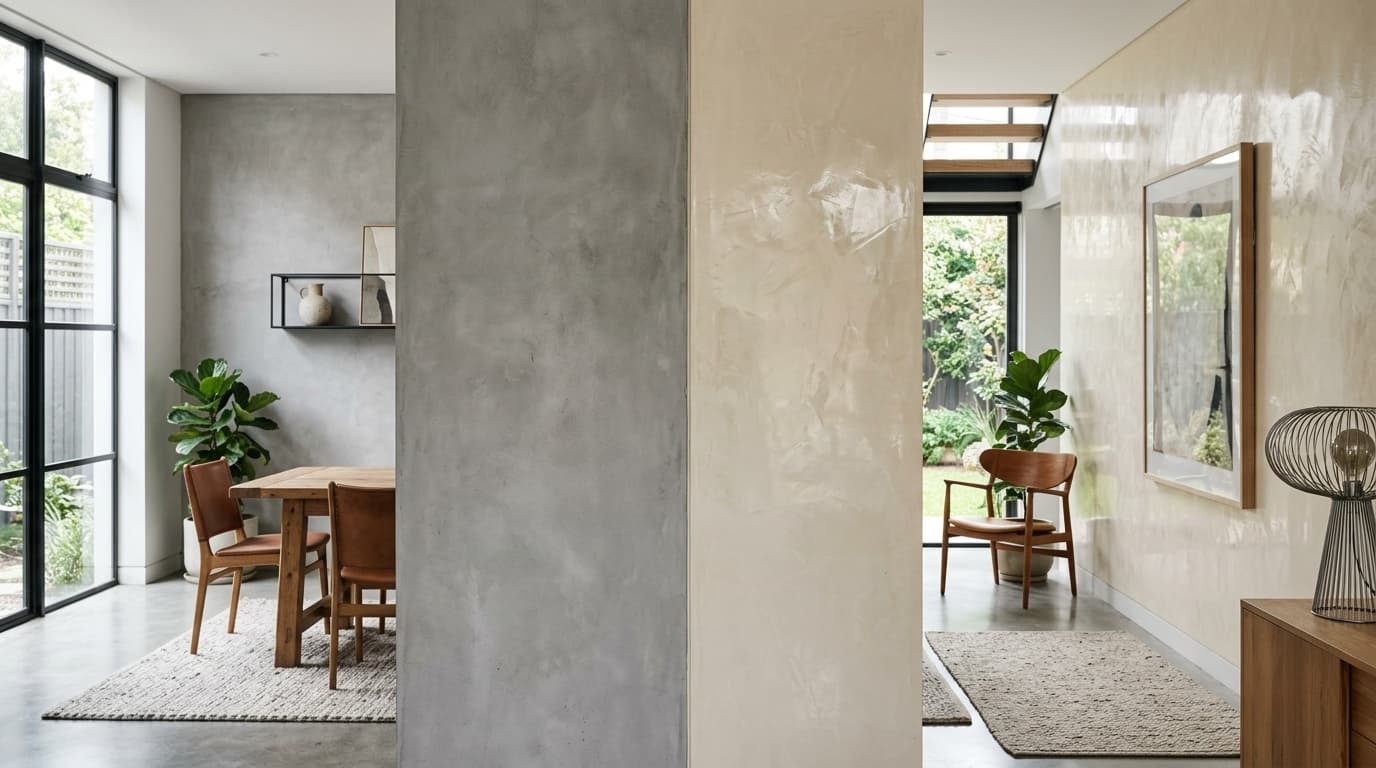
Microcement and Venetian plaster are both premium decorative finishes that we are frequently asked to compare. They share some characteristics — both are applied by hand, both are seamless, both represent a significant aesthetic upgrade over paint or tiles — but they are fundamentally different materials with different characters, different applications, and different aesthetics.
What Is Venetian Plaster?
Venetian plaster is a lime-based decorative finish with origins in Renaissance Italy. Made from slaked lime, marble dust, and natural pigments, it is applied by trowel in multiple thin coats and then burnished to a distinctive sheen. The result is a surface of extraordinary depth — the translucency of marble, with the warmth and variation of a handcrafted material.
Venetian plaster reads as organic, warm, and timeless. Its character is Mediterranean — it belongs in spaces where craftsmanship, warmth, and depth of material are valued. It is an interior wall finish only (though specialty exterior lime finishes exist as a related product).
What Is Microcement?
Microcement is a polymer-modified cementitious coating — essentially a very thin (2–3mm) concrete overlay that bonds to virtually any sound substrate. It is applied in multiple coats and sealed with a penetrating waterproof topcoat. The result is a seamless, continuous concrete-like surface that can cover floors, walls, benchtops, and wet areas without grout lines.
Microcement reads as contemporary, industrial, and precise. Its character is architectural — it belongs in spaces where clean lines, material honesty, and modern aesthetics are priorities.
Side-by-Side Comparison
| Factor | Venetian Plaster | Microcement |
|---|---|---|
| Material base | Lime and marble dust | Cement and polymers |
| Aesthetic | Warm, organic, marble-like depth | Cool, industrial, concrete aesthetic |
| Typical applications | Interior walls, feature walls | Floors, walls, benchtops, wet areas |
| Waterproof? | With specialist system (wet areas) | Yes, when properly sealed |
| Floors? | No | Yes — major advantage |
| Texture | Soft, burnished, variable | Smooth to light aggregate |
| Colour range | Unlimited, integral | 50+ colours available |
| Cost per m² | $80–$180 | $120–$200 |
| Repairability | Excellent — blends seamlessly | Good with specialist |
Which Should You Choose?
Choose Venetian Plaster if:
- You want warmth, depth, and an artisanal, handcrafted quality
- The aesthetic leans toward Mediterranean, classic, or organic
- You want a feature wall or full-room wall finish
- You have a heritage or period property
- You want something that reads as warm and human-made
Choose Microcement if:
- You want floors and walls to be the same material (continuous finish)
- The aesthetic leans toward industrial, contemporary, or architectural
- You need a waterproof finish for showers, benchtops, or wet areas
- You have a converted warehouse, terrace renovation, or modern new build
- You want the look of concrete without a structural concrete pour
Can You Use Both?
Absolutely — and in many projects, we do. A common combination is microcement for bathroom floors and shower enclosures, paired with Venetian plaster on the feature wall of the adjacent bedroom or living room. The contrast between the two materials — the organic warmth of lime plaster alongside the cool precision of concrete — is a deliberate and very effective design move.
We're happy to advise on the right finish for your specific project. Contact us for a free consultation, or explore our Venetian plaster and microcement service pages for more detail.
Target Keyword
microcement vs venetian plasterVenetian Plaster Sydney
Last updated: 5 March 2026